
Business Coaching
A segway from training to mentoring

Introduction
For me, business coaching is about exploring options through an objective eye. We have all faced situations where those closest to us in business have their own subjective needs and views. This can cloud what is right for you and your business, especially if you are a people pleaser or feel that someone ‘knows’ more than you. Another scenario is that you could be a sole owner of a business without a sounding board to bounce ideas and formulate strategies. Either way, a business coach might be the right option for you.
What I should stress at this point is that a coach does not run your business. You do. So, any arrangement you proceed with, make sure there is a clear understanding that a coach is there to facilitate, where you are going and to help you focus. Not to tell you who to hire, fire, sell or buy from.
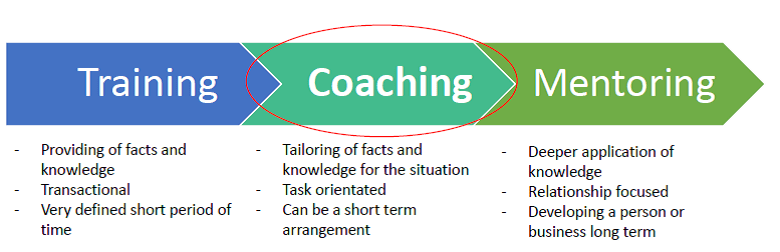
A coach will be a commercial arrangement, as with any commercial arrangement, you need to make sure the service is value for money and actually necessary. You may only need a one-off session or a series of sessions during a major project or period of expansion. You may also want to consider having a range of specialists at hand for particular areas, and therefore do not feel obligated to stick to the same person. The types of coaches you engage can evolve to suit your business needs.
Some points of clarification-
Coaches are not counsellors/therapist. It sometimes feels that way, but it’s important to stress this line in the sand. Nothing wrong with having a rant at a coach and actually, it can be quite cathartic to get ‘stuff’ off your chest. However, a coach should know when to draw the line.
Coaches are not there to run your business- A coach should listen to your issues and help structure how you approach these. The options they may suggest are just that –options. It is up to you to choose what you feel is right for your business.
A coach should fit with your business – if they no longer give you information which you understand or feel is useful, you choose when to disengage.
A coach is not an auditor – If you need someone to ‘check’ accounts or any other regulatory returns/reports be careful to engage an actually assurance provider, such as an accountancy firm. A business coach who is a qualified accountant can advise on formats and requirements and point out any obvious issues. However, unless formally engaged to do this work, a coach will not and should not approve your accounts and you should always get the appropriate qualified opinion.
Honesty- For any session to be constructive, you do need to be honest, as a coach can only act on the facts presented to them.
It is a task – a coach is there to deliver a service ‘product’, e.g. a training session, priority planning exercises etc. Mentoring is another kettle of fish, which I’ll touch on later.
Before setting out my own stall as to how I structure business coaching, you need to do some pre-work to make sure you get a good fit:
Step 1
Before approaching possible coaches, ask yourself:
Can you afford the service? Are there free services you can avail of first?
Do you need coaching or mentoring? Or a mixture of both? (This will be explained later on)
Are you prepared to listen to some hard truths?
What do you want to achieve? You need to give any potential coach some background and a goal. Be clear on the areas of your business you want to address.
How will the relationship work for you, I.E. times, place etc.
Why now? Will you utilise the options, plans and actions produced in the meeting(s)?
Step 2
Look for people who specialise in the area you are looking to be coached in. Ask around, check out their LinkedIn profile, social media presence, etc. Or you may want a completely fresh view from another industry. Eitherway, do your due diligence.
Any coach will speak to you for free to assess if they will be a fit. This will be a short conversation, via phone or email. This is the opportunity for both parties to be clear on what is needed, what could be delivered and your opportunity to make sure you are comfortable with their approach. Then agree fees. While there are hourly or day rates, if you want 5 of your people in the room, this turns into a workshop and does require more work for the coach. Only fair the added complexity is considered.
Finally, if you are not 100% comfortable discussing your business with a stranger, do not be afraid to ask for a non-disclosure agreement to be signed.
How I see business coaching
These sessions should be tailored to suit your needs and requirements. The general approach I take is to:
Meet either in person or via Skype. If a workshop arranges a suitable room.
Have a clear goal(s) agreed so everyone is clear on the purpose of the session(s).
Get a feel for you and your business – resources, budgetary constraints, look at strengths, weaknesses, opportunities and threats (SWOT), etc. I may do some of this in advance to structure the session(s) appropriately, and not all of these activities are necessary. Again depends on the goal(s) you want to achieve.
Establish any barriers or conflicts which could impact on the output of the session(s).
Then deep dive (horrible consulting term, I know!) to establish the issues, processes, priorities and plan for the goal(s).
I would usually act as a general information pool for your business.
Use strategy tools to help you and your company.
I would always send a summary and action point’s post meetings. This doesn’t need to be overly elaborate. I just want to make sure you read it and have a record of what was discussed and agreed.
The above does depend on the maturity of your business. You may need a session to cover some basics (assuming no business training), such as hiring staff, company structures, your duties as a director, doing a competitor analysis, etc. Therefore only requires steps 1), 2) & 6).
For a more mature company, you may be looking to expand and need help- managing change, scaling up your back office, scenario planning, staff training, etc. The complexity of your business will impact whether any coaching delivered morphs into another form of service, such as project management.
Finally…….Mentoring V Coaching: There is a difference…
Coaching is task-oriented and can be very short-term by its nature. Mentoring, on the other hand, is a long-term relationship working with you to develop a path for you and your business. While a coach can drift into this territory, both sides must be comfortable with the difference.
An example which I hope explains this is, if I were asked to deliver a session on leadership skills, I would pass on the knowledge and facilitate learning, but it will be up to the participants to apply this in their roles afterwards- This is coaching. However, if I added a follow-up service visiting every 4 months to see how participants put this into practice, working with them to apply and address any issues, this is mentoring.
Personally, you can have a mentoring element to coaching, especially on longer-term assignments, but there is a difference and the two roles should be clearly defined so everyone is comfortable from the start. If the relationship changes, then formally agree to this as required. I also think it is a fair consideration to note that you can have a very qualified and experienced coach on a topic, but they may not yet have the gravitas or breadth of experience to act as a mentor.
That’s OK, you have hired them to coach. Embrace their strength in acting as a great trainer and communicator of facts. Experienced professionals like myself do both coaching and mentoring. However, if I feel you need a wiser soul to mentor you through a particular period of your business, I am going to suggest this.